
A connector is not the costliest part of a system but breaking down of a connector can become very costly for the production line. In factories, vehicles, offshore platforms, and outdoor installations, one degraded contact can stop a production line or corrupt sensor data.
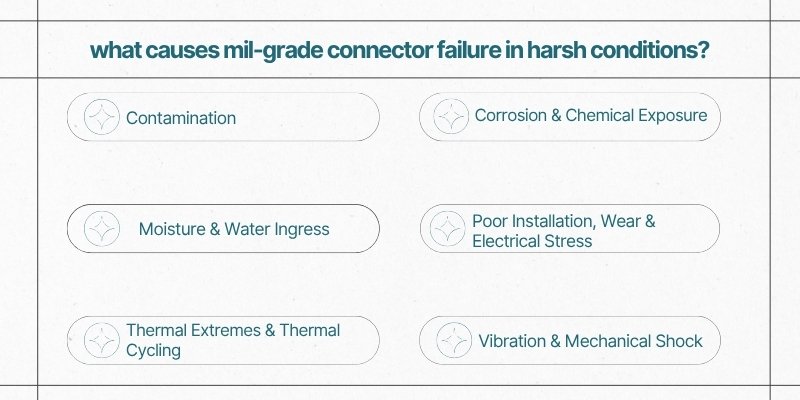
Hence, to understand what causes connector failure is very important. Here are some of the reasons –
1. Moisture and Water Ingress
Water is the most common enemy of electrical connections. Even a thin film can bridge adjacent contacts, cause short circuits, leakage currents, and signal noise, while trapped moisture drives corrosion over time. Ingress typically comes from worn or poorly seated gaskets, weak cable strain relief, condensation from temperature cycling, and high-pressure washdowns.
2. Corrosion and Chemical Exposure
Corrosion raises contact resistance, generates heat, and eventually breaks the circuit. Galvanic corrosion appears when dissimilar metals are joined in the presence of moisture. Fretting corrosion develops when tiny vibrations wear away plating and expose base metal. Salt fog attacks housings and contacts quickly in marine settings, while oils, fuels, coolants, and cleaning agents can swell or crack plastic housings and seals.
3. Temperature Extremes and Thermal Cycling
High heat softens plastics, relaxes contact spring force, and hardens seals. Extreme cold makes elastomers brittle, so they crack and stop sealing. Thermal cycling is often worse than constant extremes: materials expand and contract at different rates, loosening interfaces, opening micro-gaps for moisture, and fatiguing solder joints and crimps. Self-heating from high current adds to the load, leaving little margin in a hot enclosure.
4. Vibration and Mechanical Shock
In vehicles, heavy machinery, and rail, constant vibration causes micro-motion at the contact interface. This wears plating and creates intermittent connections that are hard to diagnose. It also fatigues wires and crimps and loosens couplings, while impacts can crack housings, bend pins, and dislodge contacts.
5. Contamination
Fine particles such as sand, cement dust, and metal shavings abrade plating, insulate contacts, and absorb moisture into a conductive paste. Outdoors, ultraviolet radiation and ozone embrittle polymers. Once a housing or cable jacket cracks, water and dirt have a direct path inside.
6. Poor Installation, Wear, and Electrical Stress
Many failures that look like an environmental begin at installation: incorrect crimping or soldering, wrong torque, tight cable bends, mismatched seals or backshells, and unmated connectors left uncapped. Repeated mating cycles also wear plating and reduce contact force, and grit and corrosion can bring a connector to end of life well before its rating. Electrical overstress, such as current overload, voltage spikes, and arcing, pits contacts and carbonizes insulation.
How to Reduce the Risk
- Match the connector to the real environment: temperature range, chemicals, vibration, and washdown needs.
- Check for IP rating and match it with actual usage of the connector.
- Use compatible materials, including similar platings in mated pairs.
- Add locking couplings and proper strain relief.
- Control installation with correct tooling, torque specifications, and training.
- Inspect regularly, keep caps on unmated connectors, and replace aging seals.
- Derate current and temperature ratings to leave margin.
Final Thoughts
Connector failure is rarely caused by one factor. Moisture, temperature swings, vibration, and contamination usually combine, each weakening the connector until a small event finishes it. Selecting, installing, and maintaining connectors with these mechanisms in mind improves reliability and cuts costly downtime.